

By Eric Carter
Education Reporter
CHICAGO - Parents and caregivers who scrambled Monday to figure out what to do with more than 350,000 idle children must do it all again Tuesday – and perhaps longer – after the teachers union and district failed to reach a settlement to end the first strike in the city's schools in a quarter century. On Monday, only about 16,000 students showed up at schools and other venues where authorities organized activities and provided meals for those in need. That means the vast majority of parents had to make alternative arrangements or leave their children unsupervised through the day.
Chicago School Board President David Vitale said he thought an agreement could be reached on Tuesday. But Chicago Teachers Union President Karen Lewis sounded less optimistic, saying the district has not changed its offers on the two most contentious issues, performance evaluations and recall rights for laid-off teachers.
The walkout – less than a week after most schools opened for fall – has created a tense political distraction for Mayor Rahm Emanuel. In a year when labor unions have been losing ground nationwide, the implications were sure to extend far beyond Chicago, particularly for districts engaged in similar debates.
"This is a long-term battle that everyone's going to watch," said Eric Hanuskek, a senior fellow in education at the Hoover Institution of Stanford University. "Other teachers unions in the United States are wondering if they should follow suit."
The union had vowed to strike Monday if there was no agreement on a new contract, even though the district offered a 16 percent raise over four years and the two sides had essentially agreed on a longer school day.
Parents and caregivers said they were upset that the two sides can't seem to agree. About 11,000 students showed up Monday at the 144 schools kept open by the district to offer breakfast, lunch and activities; another 5,000 attended activities at other sites, including churches, park district buildings and libraries.
Michelle Li walked her 5-year-old daughter, Amber, to Mays Elementary but turned back once she realized she didn't know which adults would be watching her child. She said that the kindergartner just started school last week.
"I don't understand this, my little girl just started kindergarten," she said.
Police Superintendent Garry McCarthy said he took officers off desk duty and deployed them to deal with any protests as well as the scores of students who might be roaming the streets, but police said there were no incidents on Monday.
Martha Malloy, whose husband dropped off their two elementary-age children and a granddaughter at Mays Elementary – where some picketers yelled "don't go in!" – said she doesn't blame the teachers and thinks Emanuel should give them what they want "because he's not in the classroom with those kids."
"They need to be at school and learning," Malloy said. "I don't want my children or others to get off track."
Teacher Kimberly Crawford said she is most concerned about issues such as class size and the lack of air conditioning.
"It's not just about the raise," she said. "I've worked without a raise for two years."
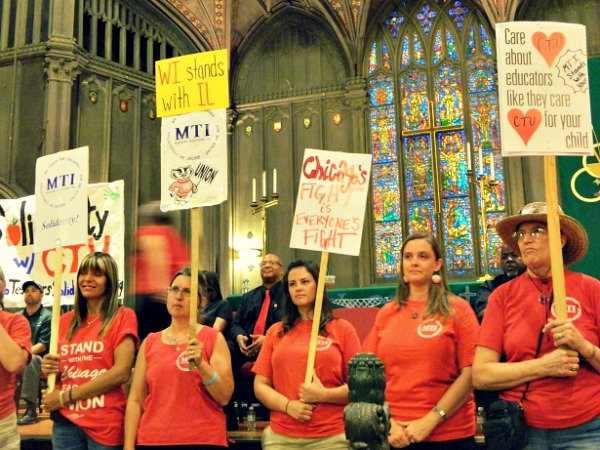
So teachers walked the picket lines at the schools in the morning, then thousands of educators and their supporters took over several downtown streets during the Monday evening rush. Police secured several blocks around district headquarters as the crowds marched and chanted.
The strike quickly became part of the presidential campaign. Republican candidate Mitt Romney said teachers were turning their backs on students and that Obama was siding with the striking teachers in his hometown. Obama's top spokesman said the president has not taken sides and is urging both the union and district to settle the dispute quickly.
Emanuel, who recently agreed to take a larger role in fundraising for Obama's re-election, dismissed Romney's comments as "lip service."
But one labor expert said a major strike unfolding in the shadow of the November election could only hurt a president who desperately needs the votes of workers, including teachers, in battleground states.
"I can't imagine this is good for the president and something he can afford to have go on for more than a week," said Robert Bruno, a professor of labor and employment relations at the University of Illinois at Chicago.
For two decades, contract agreements have slowly eroded teachers' voices, Bruno said. "But this signals to other collective bargaining units that the erosion of teachers' rights isn't inevitable. They (the union members) are telling them, `You don't have to roll over.'"
Emanuel, who has engaged in a public and often controversial battle with the union, is not personally negotiating, but he's monitoring the talks through aides.
Not long after his election, the mayor's office rescinded 4 percent raises for teachers. Then he asked the union to reopen its contract and accept 2 percent pay raises in exchange for lengthening the school day for students by 90 minutes, a request the union turned down.
Emanuel, who promised a longer school day during his campaign, attempted to go around the union by asking teachers at individual schools to waive the contract and add 90 minutes to the day. He halted the effort after being challenged by the union before the Illinois Educational Labor Relations Board.
The district and union agreed in July on a deal to implement the longer school day, crafting a plan to hire back 477 teachers who had been laid off rather than pay regular teachers more to work longer hours. That raised hopes the contract dispute would be settled soon, but bargaining stalled on the other issues.
Education Reporter
CHICAGO - Parents and caregivers who scrambled Monday to figure out what to do with more than 350,000 idle children must do it all again Tuesday – and perhaps longer – after the teachers union and district failed to reach a settlement to end the first strike in the city's schools in a quarter century. On Monday, only about 16,000 students showed up at schools and other venues where authorities organized activities and provided meals for those in need. That means the vast majority of parents had to make alternative arrangements or leave their children unsupervised through the day.
Chicago School Board President David Vitale said he thought an agreement could be reached on Tuesday. But Chicago Teachers Union President Karen Lewis sounded less optimistic, saying the district has not changed its offers on the two most contentious issues, performance evaluations and recall rights for laid-off teachers.
The walkout – less than a week after most schools opened for fall – has created a tense political distraction for Mayor Rahm Emanuel. In a year when labor unions have been losing ground nationwide, the implications were sure to extend far beyond Chicago, particularly for districts engaged in similar debates.
"This is a long-term battle that everyone's going to watch," said Eric Hanuskek, a senior fellow in education at the Hoover Institution of Stanford University. "Other teachers unions in the United States are wondering if they should follow suit."
The union had vowed to strike Monday if there was no agreement on a new contract, even though the district offered a 16 percent raise over four years and the two sides had essentially agreed on a longer school day.
Parents and caregivers said they were upset that the two sides can't seem to agree. About 11,000 students showed up Monday at the 144 schools kept open by the district to offer breakfast, lunch and activities; another 5,000 attended activities at other sites, including churches, park district buildings and libraries.
Michelle Li walked her 5-year-old daughter, Amber, to Mays Elementary but turned back once she realized she didn't know which adults would be watching her child. She said that the kindergartner just started school last week.
"I don't understand this, my little girl just started kindergarten," she said.
Police Superintendent Garry McCarthy said he took officers off desk duty and deployed them to deal with any protests as well as the scores of students who might be roaming the streets, but police said there were no incidents on Monday.
Martha Malloy, whose husband dropped off their two elementary-age children and a granddaughter at Mays Elementary – where some picketers yelled "don't go in!" – said she doesn't blame the teachers and thinks Emanuel should give them what they want "because he's not in the classroom with those kids."
"They need to be at school and learning," Malloy said. "I don't want my children or others to get off track."
Teacher Kimberly Crawford said she is most concerned about issues such as class size and the lack of air conditioning.
"It's not just about the raise," she said. "I've worked without a raise for two years."
So teachers walked the picket lines at the schools in the morning, then thousands of educators and their supporters took over several downtown streets during the Monday evening rush. Police secured several blocks around district headquarters as the crowds marched and chanted.
The strike quickly became part of the presidential campaign. Republican candidate Mitt Romney said teachers were turning their backs on students and that Obama was siding with the striking teachers in his hometown. Obama's top spokesman said the president has not taken sides and is urging both the union and district to settle the dispute quickly.
Emanuel, who recently agreed to take a larger role in fundraising for Obama's re-election, dismissed Romney's comments as "lip service."
But one labor expert said a major strike unfolding in the shadow of the November election could only hurt a president who desperately needs the votes of workers, including teachers, in battleground states.
"I can't imagine this is good for the president and something he can afford to have go on for more than a week," said Robert Bruno, a professor of labor and employment relations at the University of Illinois at Chicago.
For two decades, contract agreements have slowly eroded teachers' voices, Bruno said. "But this signals to other collective bargaining units that the erosion of teachers' rights isn't inevitable. They (the union members) are telling them, `You don't have to roll over.'"
Emanuel, who has engaged in a public and often controversial battle with the union, is not personally negotiating, but he's monitoring the talks through aides.
Not long after his election, the mayor's office rescinded 4 percent raises for teachers. Then he asked the union to reopen its contract and accept 2 percent pay raises in exchange for lengthening the school day for students by 90 minutes, a request the union turned down.
Emanuel, who promised a longer school day during his campaign, attempted to go around the union by asking teachers at individual schools to waive the contract and add 90 minutes to the day. He halted the effort after being challenged by the union before the Illinois Educational Labor Relations Board.
The district and union agreed in July on a deal to implement the longer school day, crafting a plan to hire back 477 teachers who had been laid off rather than pay regular teachers more to work longer hours. That raised hopes the contract dispute would be settled soon, but bargaining stalled on the other issues.





 RSS Feed