


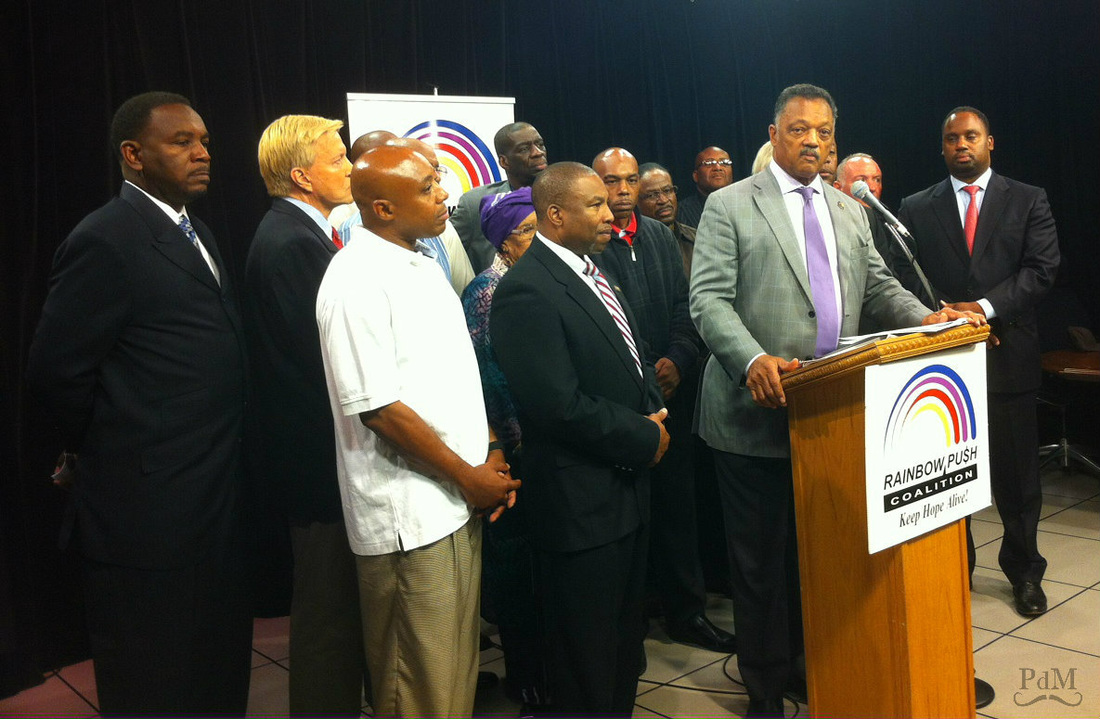
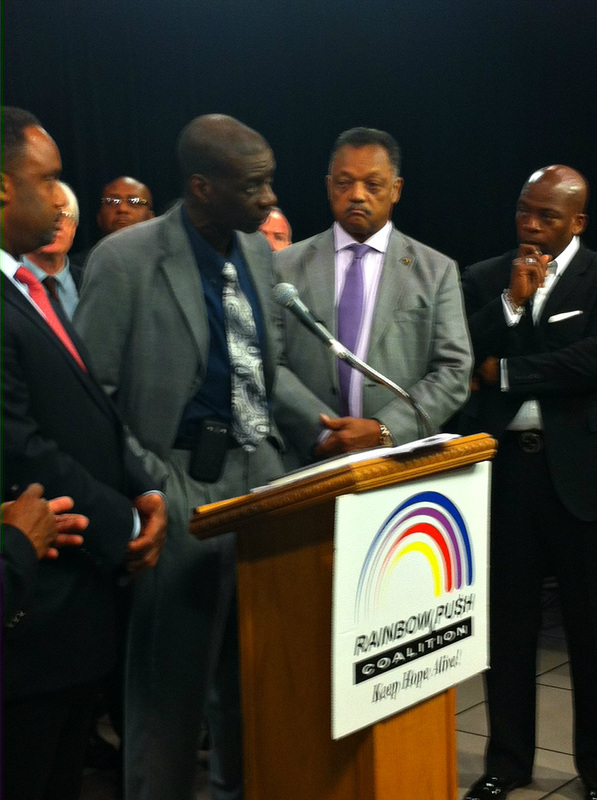
 Reverend Jackson held a press conference to discuss human rights violations across Chicago. By Jorge G. Zavala | Creative Director Human rights violations, specifically within the judicial system in Chicago, have received attention in recent months. Last month, Reverend Jesse Jackson held a press conference, that included 2nd Ward Alderman Bob Fioretti and several men who were incarcerated unjustly, to bring light to the injustices he says are "plaguing communities...across Chicago."
Mark A. Clements, current prison liaison for the Chicago Alliance Against Racist and Political Oppression (CAARPR), is a former inmate who served time unjustly. "I was beaten, humiliated, and taken from my mother at 17 years of age," Clements stated. "My mother is now gone, and, what's worse, they found out that I really didn't commit (the crime) 25 years later." Clements was accused of a homicide in the city's Englewood neighborhood in the 1980s, but recent evidence and a re-trial proved him innocent. How did the city compensate his years in jail? "I received $50 and a bus pass," Clements laughed. "Do they think $50 is enough? I laugh because I am humiliated: we've become a joke."
Organizations across Chicago, like Reverend Jesse Jackson's Rainbow-PUSH Coalition and the Greater St. John Bible Church, are working together with local politicians, the Illinois State Attorney's Office, and community leaders, to bring awareness to what is happening and to advocate for fair trials. "It's still a predominantly black and brown problem," Reverend Jackson stated. "But these problems affect everyone, including the better-off black, brown, and white communities in the suburbs." 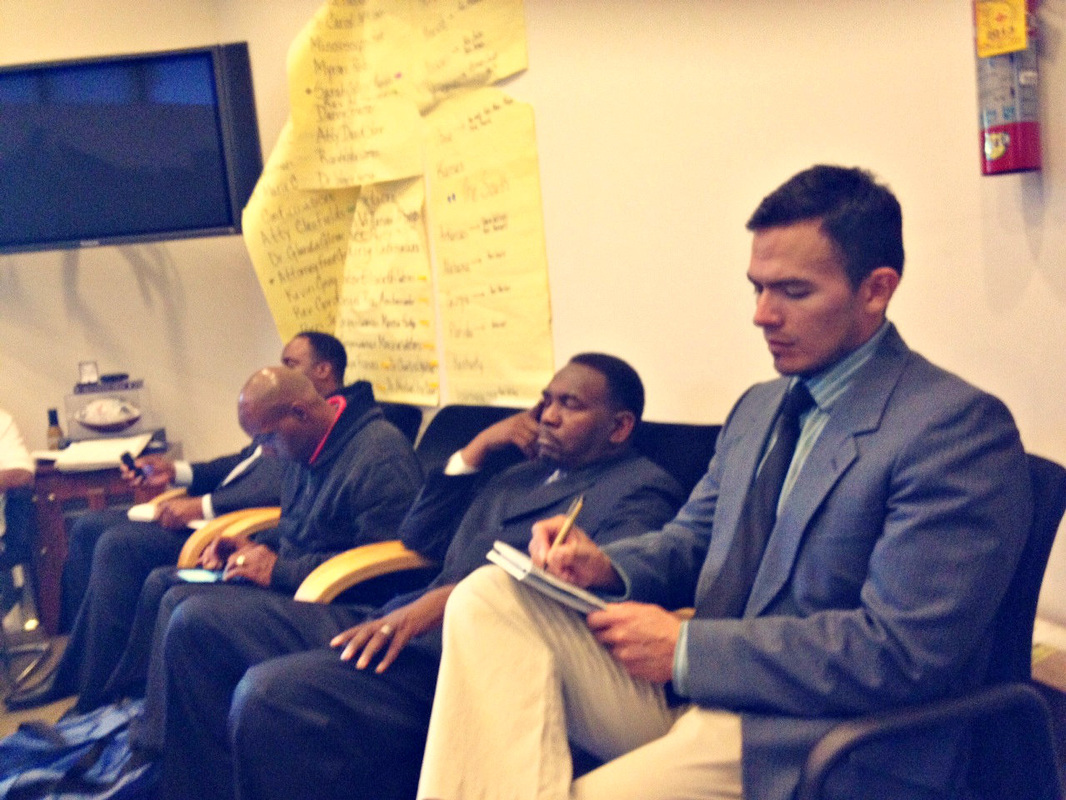 As for Mark Clements, he is currently suing the City of Chicago and the State Attorney's Office for negligence and wrongful accusation. "Yes, the money would be nice, but I am not suing just for the money," he stated. "Police brutality, ignorance, and a broken system keeps putting innocent people in jail. This can't go on anymore: lives are broken."
 Delia de Avila was seen harassing a journalist and tossing her phone to the ground before the first runway show for Latino Fashion Week. Photo Credit: Carlos Mora By Sandy Chang | Investigative Reporter
This is a developing story. On October 1st, 2013, Latino Fashion Week opened its doors to a diverse set of interested fashionistas, politicos, and members of the community. It also opened its doors to bloggers and members of the press. While most of the evening was composed of free-flowing cocktails and pictures with the who's who of Chicago's developing Latino fashion scene, an incident did occur that, according to witnesses, made for an uncomfortable evening. Delia de Avila, coordinator for Latino Fashion Week, is said to have harassed a young journalist to the point of physical confrontation before the start of "The Journey", the fashion show anticipated by both guests and media. The young woman, who represents a notable fashion blog based in Los Angeles, stated that Delia "grabbed her arm, tossed (her) phone to the ground as (she) was filming the confrontation, and yelled obscenities". A witness, who preferred not to be identified, told PdM that Delia appeared to be under stress and "seemed shaken up" before confronting the 22 year old journalist and kicking her out of the show. "It's really a shame to have experienced that," stated Arturo, a student at the Illinois Institute of Art. "I was standing right behind Delia as she screamed at the poor girl: who does that?" It appears that while "The Journey" for those watching the fashion showcase was an enjoyable endeavor, the ride for the young fashion blogger was not so smooth. Ms. Avila has failed to comment on the matter. 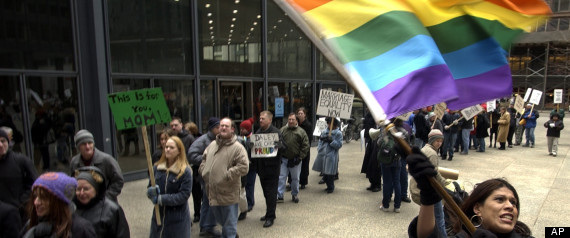
WASHINGTON -- The Defense of Marriage Act (DOMA), the law barring the federal government from recognizing same-sex marriages legalized by the states, is unconstitutional, the Supreme Court ruled Wednesday by a 5-4 vote.
"The federal statute is invalid, for no legitimate purpose overcomes the purpose and effect to disparage and to injure those whom the State, by its marriage laws, sought to protect in personhood and dignity,” Justice Anthony Kennedy wrote in the majority opinion. “By seeking to displace this protection and treating those persons as living in marriages less respected than others, the federal statute is in violation of the Fifth Amendment.” Justice Kennedy delivered the court’s opinion, and was joined by Justices Ruth Bader Ginsburg, Stephen Breyer, Sonia Sotomayor and Elena Kagan. Chief Justice John Roberts and Justices Antonin Scalia and Samuel Alito all filed dissenting opinions. DOMA, signed by President Bill Clinton in 1996, prevents same-sex couples whose marriages are recognized by their home state from receiving the hundreds of benefits available to other married couples under federal law. During the Obama administration, the Justice Department initially defended DOMA in court despite the administration’s desire to repeal it. But the Justice Department changed course in early 2011, finding that the law was unconstitutional and declining to defend it any longer. House Republicans have since spent hundreds of thousands of dollars taking over that defense. Plaintiff Edie Windsor, 84, sued the federal government after the Internal Revenue Service denied her refund request for the $363,000 in federal estate taxes she paid after her spouse, Thea Spyer, died in 2009. During the March arguments in United States v. Windsor, a majority of the court seemed to express doubts about the constitutionality of DOMA. Justice Ruth Bader Ginsburg said that supporters of the law seemed to want "two types of marriage," likening same-sex unions to the "skim milk" version of marriage. 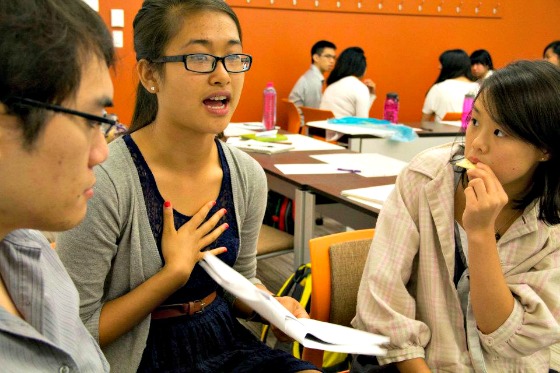 Lin Chao (center), a senior high school student at Mather High School, will graduate this June. Photo Credit: Bill Chao By Chuck del Valle | Lifestyle and Society Reporter
CHICAGO - Even after a tough school year that included the city's first teachers strike in 25 years and the district threatening to over 120 of its schools before finally progressing with their plan to shutter 50, Chicago Public Schools has hit a record high graduation rate. CPS CEO Barbara Byrd-Bennett and Mayor Rahm Emanuel announced Friday morning the district is on track for a 63 percent five-year graduation rate -- a two percentage point increase over last year's record-setting rate and a predicted 19 percentage point increase over 10 years ago, according to CPS records. The district stated that attendance is also up: the district is on track for an attendance rate just under 93 percent this year, an increase over last year's 92.5 percent and the 2010-2011 year's rate of 91.7 percent, NBC Chicago reports. "That's more than 4,000 of the city's children attending school regularly than two years ago," mentioned Tanya Collier, an educator on the city's south side. "We are progressing slowly, but slow is better than never." Byrd-Bennett credited a longer school day and a more "rigorous curriculum" among the factors contributing to the improvement, according to DNAinfo Chicago. She was quick to add in a statement, though, that more work remained. "This graduation rate is a testament to our hard-working students, educators and administrators, but we know there is more to do," Byrd-Bennett said in a statement. Emanuel stated similar comments in a brief interview, describing CPS's 2013 graduates as "shining examples of the promise of Chicago’s future" while also admitting "there is still more to do." While CPS noted the projected graduation rate is its highest ever, it also clarified that the numbers date back to only 1999, when the district changed how it tracked graduation data, according to NBC Chicago. And despite the improvement, CPS still trails the estimated national average graduation rate for incoming public school freshman of 78.2 percent, as of 2009-2010. "Parents, students, educators, we all want miracles," Collier stated. "The reality is that for most of these kids, getting out of bed and making it to school is already progress." 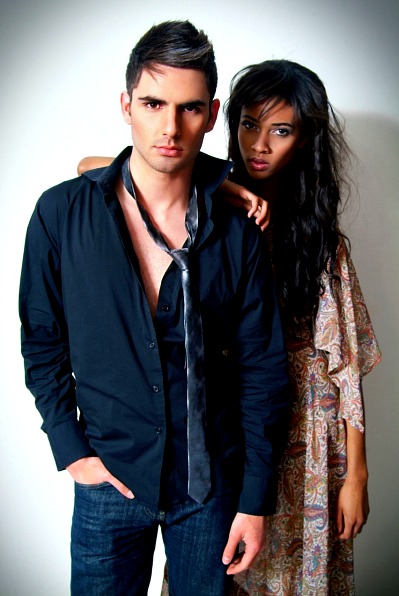 By Chuck del Valle | Lifestyle and Society Contributor
For many people, dating outside one's race is hardly an issue. However, for a handful of individuals interracial dating is still considered wrong and many are passionately opposed. Amy Yee, a screenplay writer based in San Francisco, made note that many of her friends, who come from diverse backgrounds, see interracial dating as a challenge to their well-being. “I have about three Asian friends who date outside of their race," she said. “But all the other friends of mine, it’s either they vocally say that they won’t or every time an opportunity comes up for them to date outside of their race, there’s some excuse why it’s not going to work." Yee, who is currently dating a Turkish-American from New York City, feels very passionate about discussing the issue of race and love. "Many of my friends will say things like, ‘Well, you know he works at such and such, and our schedules don’t match.’ But we’ll know really what it is. It’s because he/she is black, white, Latino, Arab, etc.” In today’s ever-diversifying world, it would make sense for more people to begin dating outside of their race. It turns out, however, that there’s still a tinge of racism within even the new melting-pot mentality. According to a 2012 piece from NPR, almost 7.2 percent of all marriages in the United States are now interracial. However, not all interracial relationships are created equally: As of 2012, just 0.3 percent of white men in marriages were married to black women, and just 0.8 percent of white women in marriages were married to Black men. By contrast, 2.1 percent of white men in marriages were married to Asian or American Indian women, and 1.4 percent of married white women had an Asian or American Indian spouse. That meant that last year, white Americans were in marriages with Asians far more often than with Blacks, even though the number of married African-Americans outnumbered Asians by more than 2 million people. When compared to the number of Latinos dating Asian/Asian-Americans, the numbers were a bit vague, but a strong 1.2 percent existed between Latin men and Asian women. The most common Asian-American group to date outside of their race was Filipino while the least likely groups to date outside of their background included Pakistani and Korean-Americans. In a survey carried-out by the Pew Center in 2012, men were 67% likely to not date a black woman compared to women of other races. The most popular women to date, according to the 72,672 male participants, were Latin and white women. It’s a fact that Americans are still not dating outside of their race, despite the overwhelming 74% of the nation that approves of such. In addition, the NPR survey concluded that immigration and citizenship status also affect a race-based mindset, particularly as it relates to Asian women. That being said, the survey stated that whites are less open to the idea of marrying a black person than vice versa, Latinos are more likely to have an open-mind to date outside their race, and Asians prefer to marry other Asians or marry white-men, particularly as it relates to citizenship and visa status. "I believe that the reason Asian-American women are not valued in society is due to the misconception that we want a visa in exchange for partnership," Yee stated. "The infamous 'visa for love' is quite common between Asian women and white men the world over, but it's a hurtful stereotype because many of us aren't looking for a visa." Josh O'Shea, an accountant based in Chicago, mentioned that racism isn't something he's consciously developed in a relationship. "I'm as white-bread as you can get," O'Shea laughed. "But I know that I am open to learning about other people, other cultures, and how life affects the woman I love." Josh, a native of Evergreen Park on Chicago's south-side, knows that racism is a common way of life for many Chicagoans, particularly those hailing from working-class neighborhoods. "I got harassed so much for dating a black girl in college: we used to get called the foulest names," O'Shea stated. "When I dated an Asian girl last year, they asked if I was ready to sponsor her family and get the paper-work rolling: they were dead serious." Despite the fact that it is 2013, racial barriers are still a major factor in people’s lives. Like Amy and Josh's experiences, the experiences that come with interracial dating reflect more than the moment someone makes a nasty remark. "It's only the beginning of a long, overdone conversation," Yee commented. "I wish it were as simple as saying that one individual is playing ignorant, but the reality is that society doesn't embrace interracial dating, not just yet. As someone living in San Francisco, interracial dating is a bit more tolerable on this end, but I would never move to Kentucky or consider the Midwest a place to raise bi-racial children." Old prejudices die hard, even where love is concerned.  By Sara Schwartzkopf | Society Reporter
November 30th concluded Native American History Month with some excellent news for the Native American community ;particularly for the Great Sioux Nation. Since September, tribal leaders have been struggling to raise $9 million for the purchase of Pe’Sla (pronounced pay-slah) and the surrounding area in the Black Hills of South Dakota. On November 30th, they announced that they had succeeded and officially purchased back the land from the Reynolds family. The history of Pe’Sla and its significance to the Great Sioux Nation is a story that is rarely taught in public schools. In 1868 the U.S. government signed the Treaty of Fort Laramie, giving the Black Hills legally to the Lakota Sioux and closing the land to white settlement. Less than 6 years later, George Armstrong Custer’s expedition discovered gold, and white miners rushed into the land, sparking another war. By 1877, the U.S. government had taken control of the land again and removed the Lakota to reservations outside of their legal territory. Homesteaders and miners moved into the territory and claimed it as their own. In 1980, the Supreme Court of the United States ruled that the land had been taken illegally and that the government had to pay the initial offering price plus interest – close to $106 million. The Lakota refused the money, stating that they had never sold the Black Hills, never would, and that the land should be returned to them. The money remains in an interest-bearing account, now worth over $750 million. It has not been touched. Pe’Sla itself is integral to the Sioux creation story and way of life. Together the Sioux are made up of Lakota, Dakota, and Nakota tribes, and are spread out between South Dakota, Montana, Minnesota and Canada. Pe’Sla is considered the Center of the Heart of Everything and its location is reflected in the constellations above the area. There are a number of stories and beliefs connected to the area as well as prayers and ceremonies that need to be carried out on the land itself. The Sioux do this yearly for the benefit of humankind. The near 2,000 acre stretch of Pe’Sla has been in the Reynolds family since 1876. During that time they left it mostly undeveloped, and allowed various bands of Native Americans to come onto the property for prayer and ceremonies that are integral to their way of life. The announcement of auction came in mid-July, proposing that the land be auctioned off in 300 acre parcels, most likely for ranchettes. After outcry from the public, the Reynolds family came to an agreement with the Rosebud Sioux tribe to let them buy back the land for $9 million, provided that it be paid by the end of November. Over the course of three months, the Rosebud Sioux Tribe came together with Crow Creek Tribe, Shakopee Mdewakanton Sioux Tribe, and countless individuals to raise millions. Over time the effort received press from abroad, and endorsements by celebrities like P. Diddy and Bette Midler. “The Perks of Being a Wallflower” star Ezra Miller travelled with music producer Sol Guy and Chase Iron Eyes from Last Real Indians to produce a video and raise awareness of the issue. Last Real Indians ultimately raised $900,000 for the purchase. Many of the donations came from some of the poorest communities in the United States. With many of the reservations sitting at poverty rates around 40%, these donations did not come easily. However, the importance and significance of buying back the land was not lost. To be sure, the irony of having to buy back land that was legally declared theirs is not lost on many of the Lakota. Oglala Sioux president-elect Bryan Brewer said, “I’m still against buying something we own, but I’m thrilled the tribes are buying it.” The three tribes that did allocate official funds released the following statement Friday: “The historic requisition of Pe’ Sla started today in Rapid City, South Dakota. The Rosebud Sioux Tribe, the Crow Creek Tribe, and the Shakopee Mdewakanton Sioux Tribe community gathered in a historic assembly of the United Tribes. Pe’ Sla is sacred because it is related to the Lakota creation and it is the site for annual ceremonies. It has historically hosted many village gatherings. Black Elk, the Lakota visionary sought his visions at Pe’ Sla. It is the high mountain on a prairie in the heart of the Black Hills. The land of Pe’ Sla was once protected by the 1868 and 1851 Sioux nation treaties. The United States violated those treaties and took the Black Hills in violation of the fifth amendment of the Constitution. Today the requisition is a historic event for the Lakota, Dakota and Nakota people. The tribes will work together to form the Oceti Sakowin Sacred Land Protection Commission to protect Pe’ Sla. We will preserve the sacred site for traditional and cultural ceremonies and keep it in a pristine state for our future generations. We are grateful to stand together before the creator and to help our people in reclaiming one of our most sacred sites. We are not waiting for the United States to deal with this justly on the Black Hills rights and we ask that now that we are exercising our inherent sovereign authority to protect this most sacred site. We must perpetuate our way of life for future generations. We thank the members of the public who donated to this cause to create justice for all people and now we are more determined than ever that the United States must provide justice for our people. We thank the Reynolds family for working with us in our requisition of Pe’ Sla as a sacred site for Lakota, Nakota and Dakota people.”  Pilgrim and Indian-themed parties, like the many others conjuring up similar images associating different racial groups to stereotypes, have become increasingly popular in the last decade. By Sara Schwartzkopf | Society Reporter
November is Native American Heritage Month. Similar to February being Black History Month and September/October being Latino History Month, November is meant to be a time to mark Native American contributions, history and contemporary issues. Coincidentally, it falls post-Columbus Day (or Indigenous People’s Day if you refuse to celebrate Columbus), and coincides with Thanksgiving. In a grand display of ignorance though, this month has thus far witnessed the following: No Doubt released a video for their new single “Looking Hot” that featured Gwen Stefani in multiple headdresses and feathers, wearing very little clothing, hanging out with a wolf in a tipi, and being tied up and writhing while white cowboys pointed their guns at her. Victoria’s Secret sent supermodel Karlie Kloss down the runway wearing a leopard print bikini, fringe, turquoise jewelry and a floor-trailing war bonnet. Even Friday, popular Native comedian/activist group ,the 1491s, brought attention to an Irish bar named McFadden’s that had put out a promo poster for an upcoming pre-Thanksgiving party, telling potential customers to “Party like a Pilgrim, Drink like an Indian [sic].” The interesting thing here is not necessarily that non-Natives have done something offensive, but that the responses on both sides of the issue have been incredibly similar. In all three of these cases (and in others that date prior to this month) the Native community has responded quite loudly through social media. Twitter feeds flooded, Facebook was inundated with images, shares, and comments, more comments and dislikes on Youtube, as well as blog posts and online articles popped up within a few hours. Social media and networking means that groups and individuals across the United States can take part in the pushback. In the case of the No Doubt video, “Looking Hot” was released on November 2nd, and the band pulled the video offline and offered an official apology on November 3rd, stating that their “foundation is built upon diversity and consideration of other cultures” and that, “Being hateful is simply not who we are.” With Victoria’s Secret it took two days for them to announce that they were sorry they had offended people and would pull the footage before their show aired on December 4th. Even smaller, more local offenses like McFadden’s are being met with hundreds of phone calls and messages informing them of how racist their marketing campaign is currently being viewed. Late Friday afternoon, McFadden’s of DC emailed an apology, canceled the event and instead offered a complimentary cocktail hour from 8-9 PM on the 20th. It is interesting that so many Natives and their allies take to social media to effect change. There’s a new breed of activists in the Native community, or as Native journalist, Simon Moya-Smith, coined them, Digi Skins, meaning those Natives who use the Web to raise awareness about issues important to them and to combat American ethnocentrism. This can be viewed as both a continuation of more traditional communities, and a solution to how dispersed Natives are across the United States, and even the world. Social media allows for Natives to connect with each other on Native issues, regardless of living on reservations or in cities, regardless of tribal affiliation, and regardless of class or occupation. In the case of activism, it allows for a Lakota studying in Egypt to connect with an Alaskan Native at home, and for them both to petition their government to extend the Violence Against Women Act. This trend in Indian Country is helping to bridge physical space and pull the community together.  Voting is sexy. "Bad officials are elected by good citizens who do not vote." -Andrew Lack Voting is a fundamental right under the United States Constitution. Make sure to exercise your right to vote today! Polling booths will close at 7pm, so ensure that your voice is heard by voting early.
Remember, if you don't vote others will decide for you.  By Sara Schwartzkopf
Society Reporter On October 15th, The Doctor Phil Show featured the story of Matt and Melanie Capobianco, a couple that adopted a Cherokee baby named Veronica more than two years ago. Under the Indian Child Welfare Act of 1978, Veronica was removed from their home in January 2012 to live with her biological father, who is also a Cherokee citizen. The case has received much attention nationally, and some opinions of the case see the court’s decision as positive for the ICWA, the Cherokee Nation, and Veronica’s biological family. Others have criticized the decision as being traumatic to the toddler and wildly unfair to the adoptive parents. The presentation on The Doctor Phil Show has been criticized as one-sided by Native Americans, since much of the show ignored the reasons behind the ICWA and why it was applied in this case. Of course, the case is emotional for all involved. However, the grief of the adoptive parents was certainly highlighted. The Indian Child Welfare Act was enacted by Congress in 1978 in order to help protect and preserve Native tribes and families. It does this by ensuring that tribes have jurisdiction over Native children both on and off reservations. Prior to this a 1976 study estimated that 25-35% of all Native children were removed from their families and placed in non-Native homes. In some cases the per capita rate for Native children vs. non-Native children in foster care was 16 times higher. These children presumably were growing up outside of their heritage and culture, and outside of their extended family networks. The intended effect was assimilation and the destruction of tribes as separate nations. With the ICWA, preference for Native adoptions are given first to family members, then to other tribal members, then to members of outside tribes. If these are not options for a child, then the child can be adopted by a non-Native family. Few, if any, of these facts were explained during The Doctor Phil Show. Instead Matt stated that, “The Child Welfare Act is destroying families,” and told of how he and his wife were selected by Veronica’s birth mother to be her adoptive parents. However, Veronica’s birth mother, Christina Maldonado, signed the adoption papers without the consent of Veronica’s biological father. According to reports, he was unaware of the adoption process for four months and was only informed shortly before he was sent to Iraq. In order to get her back, he sought help from his tribal government and his parental rights were upheld through three court decisions. According to the National Indian Child Welfare Association, both the Capobiancos and their attorneys knew that Veronica is Native and that her adoption would fall under the ICWA. They state, “the Capobiancos were advised to circumvent the law, putting Veronica at high risk.” Indeed, the portrayal of the case ignored the fact that Veronica is now with her father, sister, stepmother, grandparents, and an extended network of community that will all serve to keep Veronica connected to her heritage. |
PoliticaFrom Chicago to New York City, Tokyo to Bangkok, we have the latest developments on local and international movements. 
Archives
March 2014




|
 RSS Feed